Novorésumé: building beyond the resume
How I led new-product discovery and delivery across job-search workflows, career learning and AI-assisted application tools.
At a glance
The challenge. Novorésumé was strong at helping people create application documents, but that relationship was naturally episodic. At the same time, generative AI was rapidly changing what users expected from career products. The opportunity was to become useful across more of the job-search journey while reducing repetitive work.
My role. I progressed from UX Designer to Product Owner and eventually Head of Innovation. I owned Job Tracker from discovery through delivery and iteration, owned product direction and delivery for Novocareer, and drove exploration of AI-assisted workflows across the wider product.

Job Tracker, Novocareer and multiple AI-assisted application tools expanded the product beyond resume creation and created new reasons for users to return throughout their job search.
How could Novorésumé support the job search rather than only the documents created during it?
Job searching is fragmented. People move between job boards, documents, emails, notes, interview preparation and deadlines, often while applying for several roles at the same time. Our research showed that the friction was not simply writing a resume. It was keeping the whole process understandable and moving forward. That question became the foundation for Job Tracker, Novocareer and our experiments with AI.
Make the job search visible
Job Tracker
The first opportunity was organisational rather than generative. We started with a simple Kanban-style workflow where users could create opportunities and move them through stages.
The important decision was what not to build. Instead of starting with heavy automation, we first wanted to validate whether having the entire application journey visible in one place was useful. Once the core behaviour was established, we began adding features around the repetitive parts of the process.
My contribution: user interviews and surveys, product framing, requirements and acceptance criteria, information architecture, UX/UI, prioritisation, release planning, QA and iteration.
Start with the workflow before automating the workflow.
That allowed us to learn how people actually used the product before increasing technical complexity.
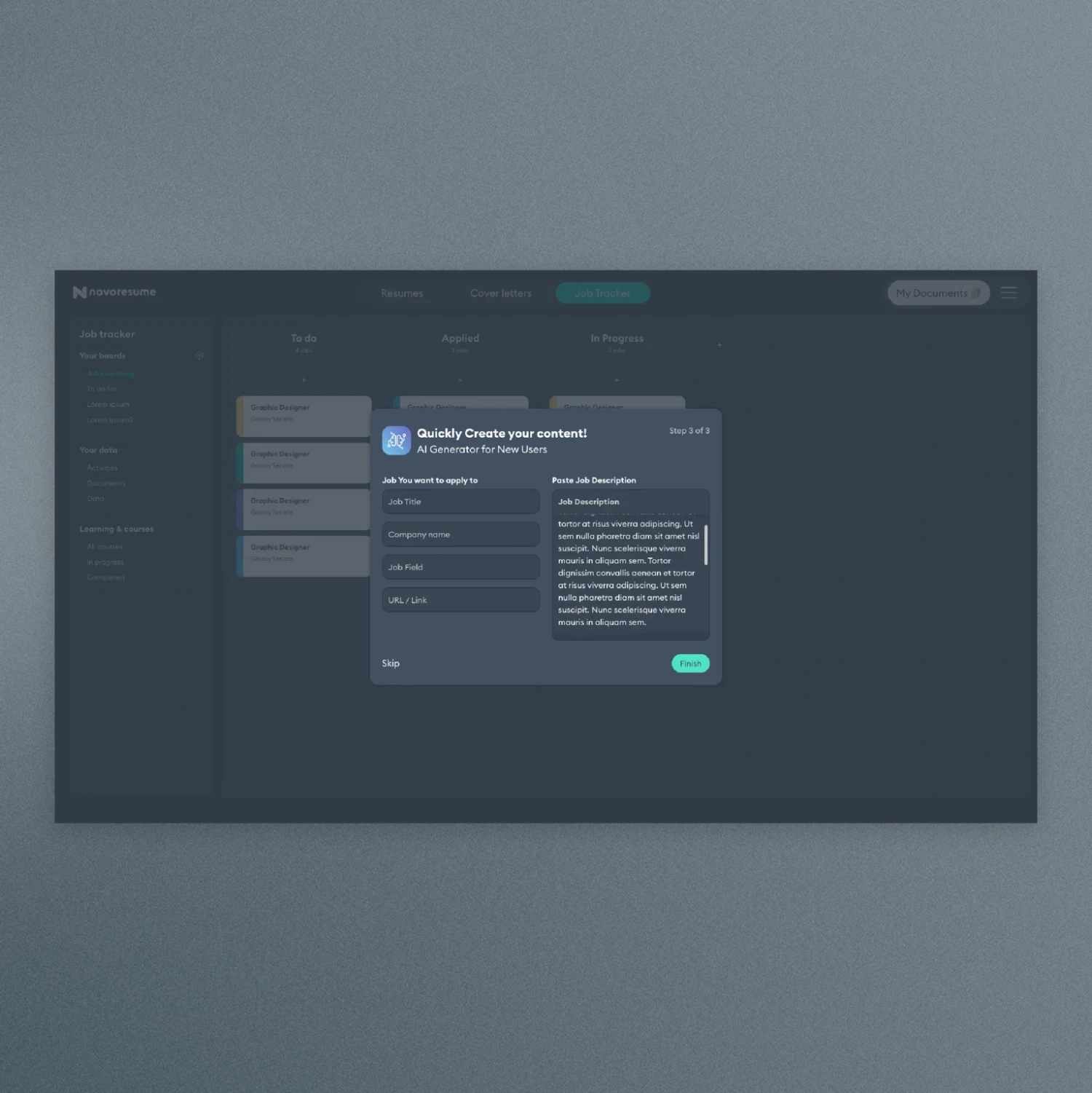
The first release deliberately kept the application workflow simple: opportunities, clear stages and visible next actions.
Use AI where effort repeats
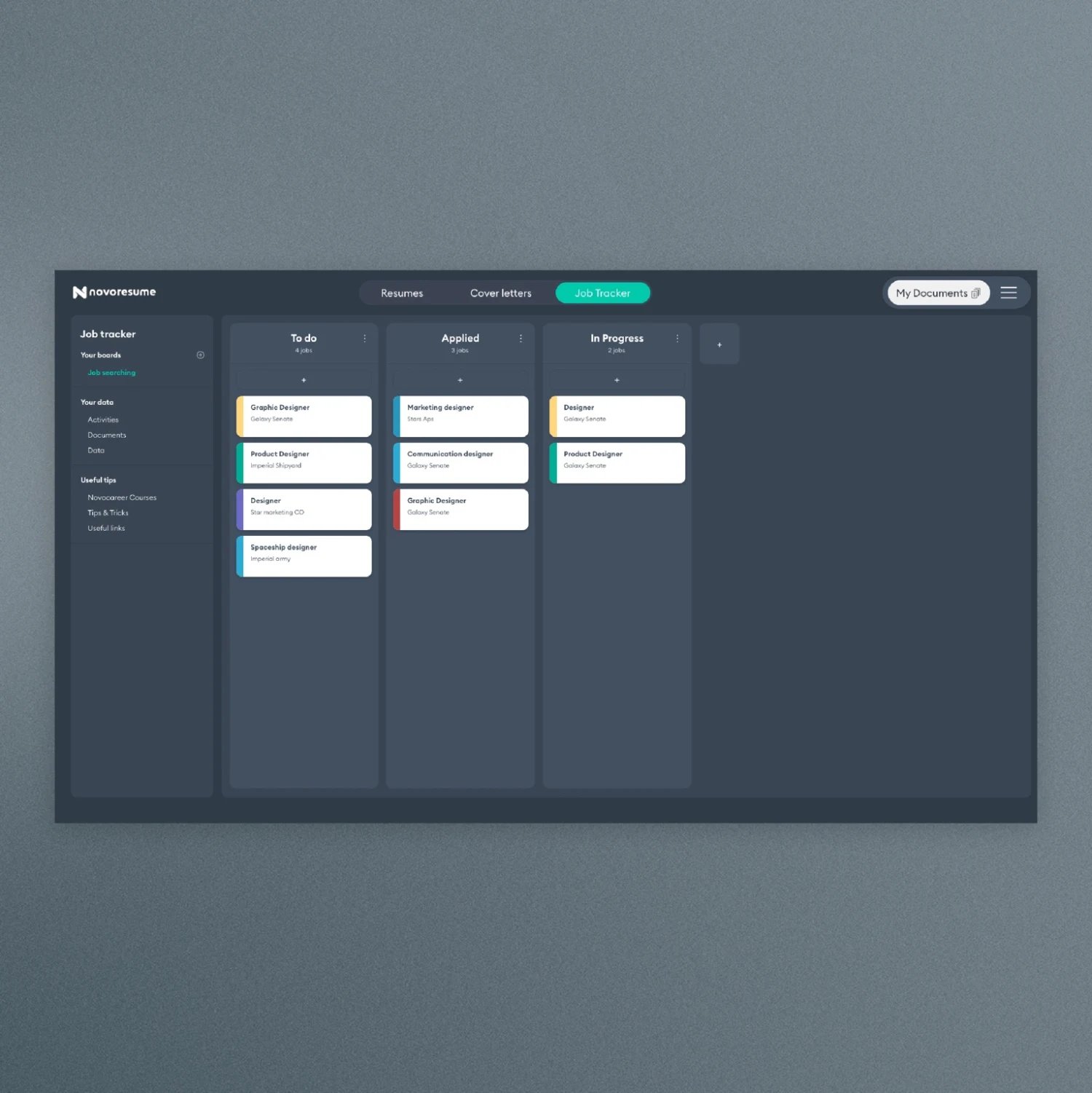
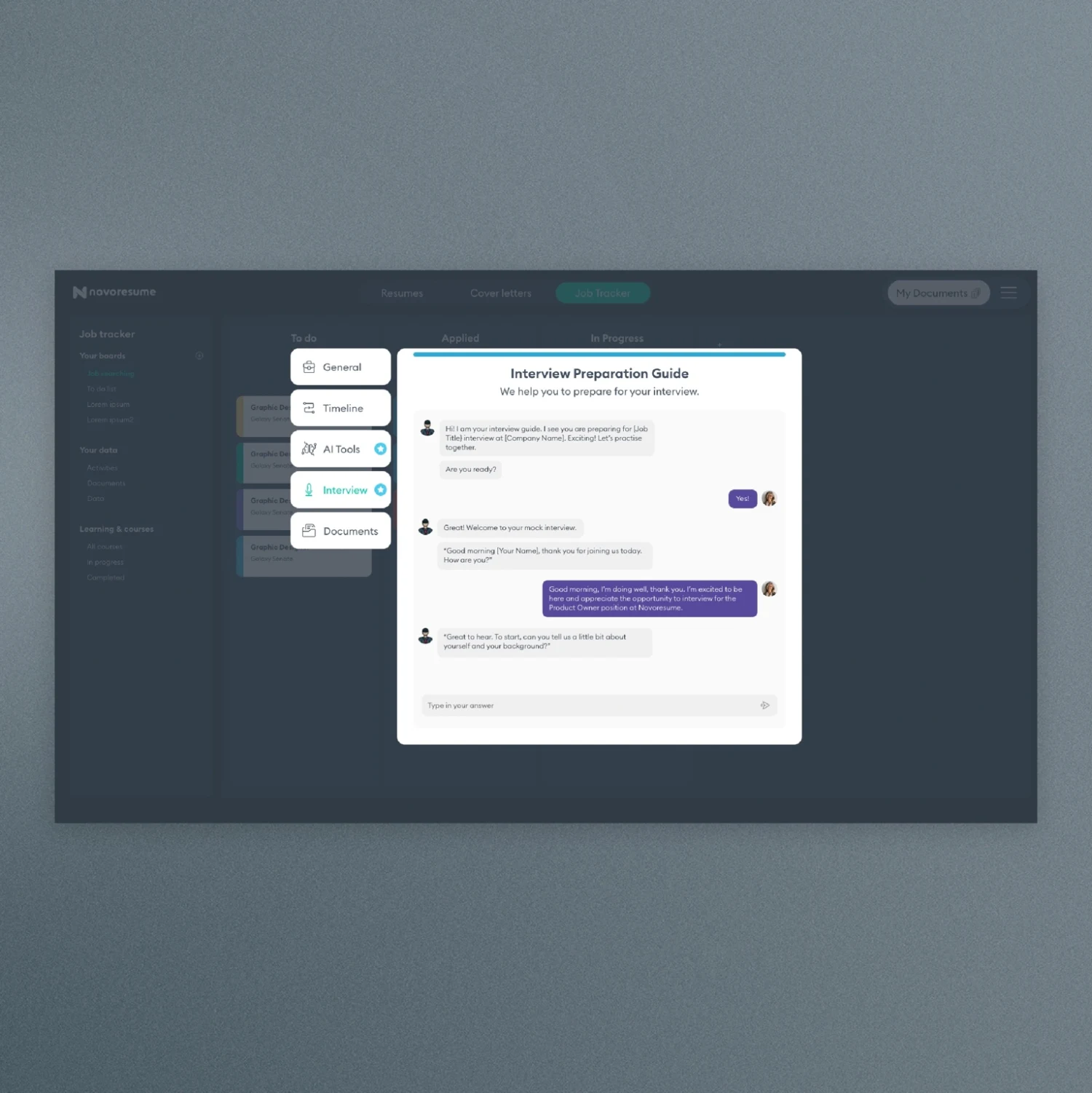
Generative AI created an obvious opportunity, but simply adding a chatbot would not make the product better. We focused on moments where users repeatedly had to turn similar information into a new output: cover letters, application emails, follow-up emails, thank-you messages, interview preparation, salary and negotiation support.
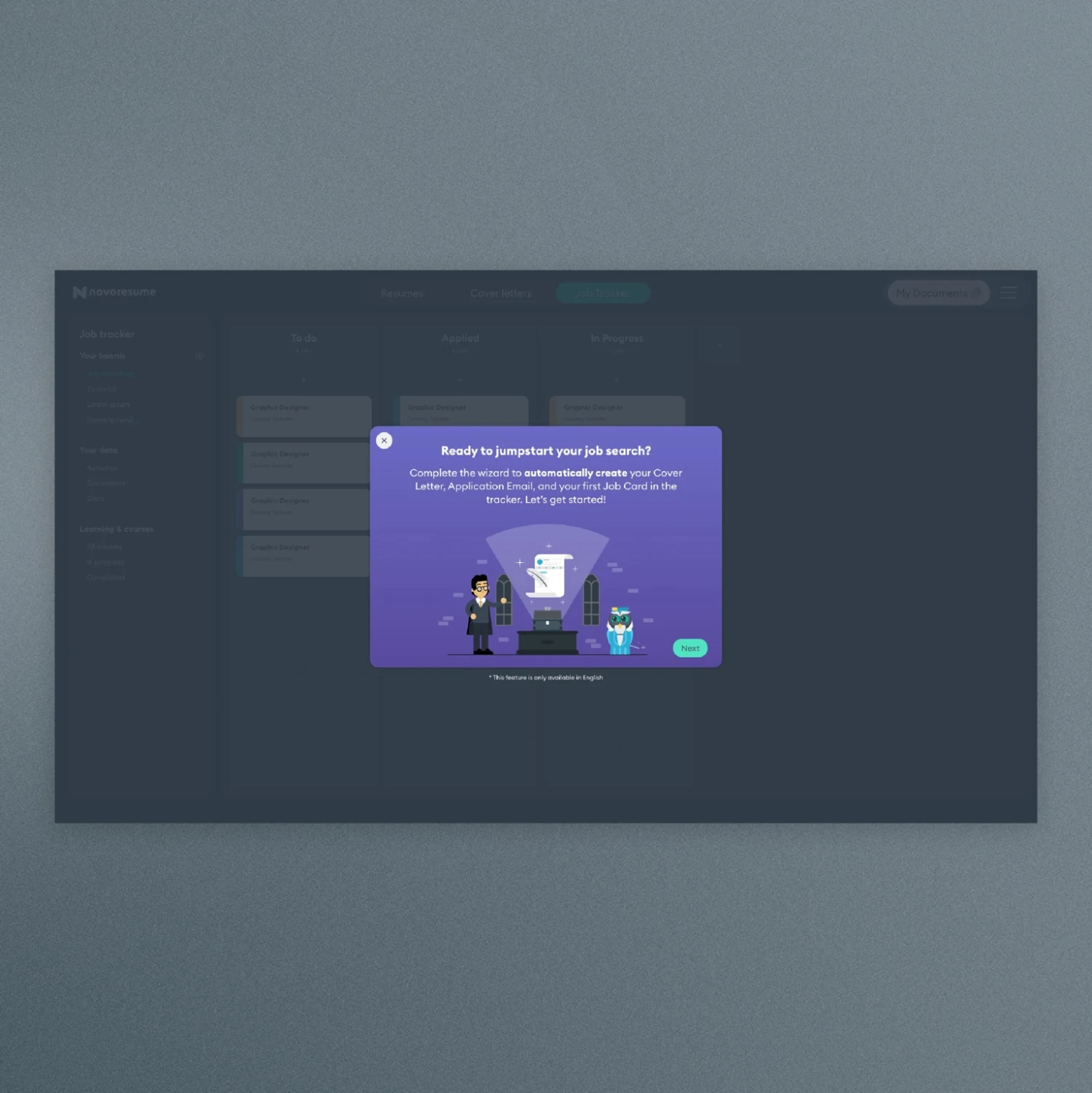
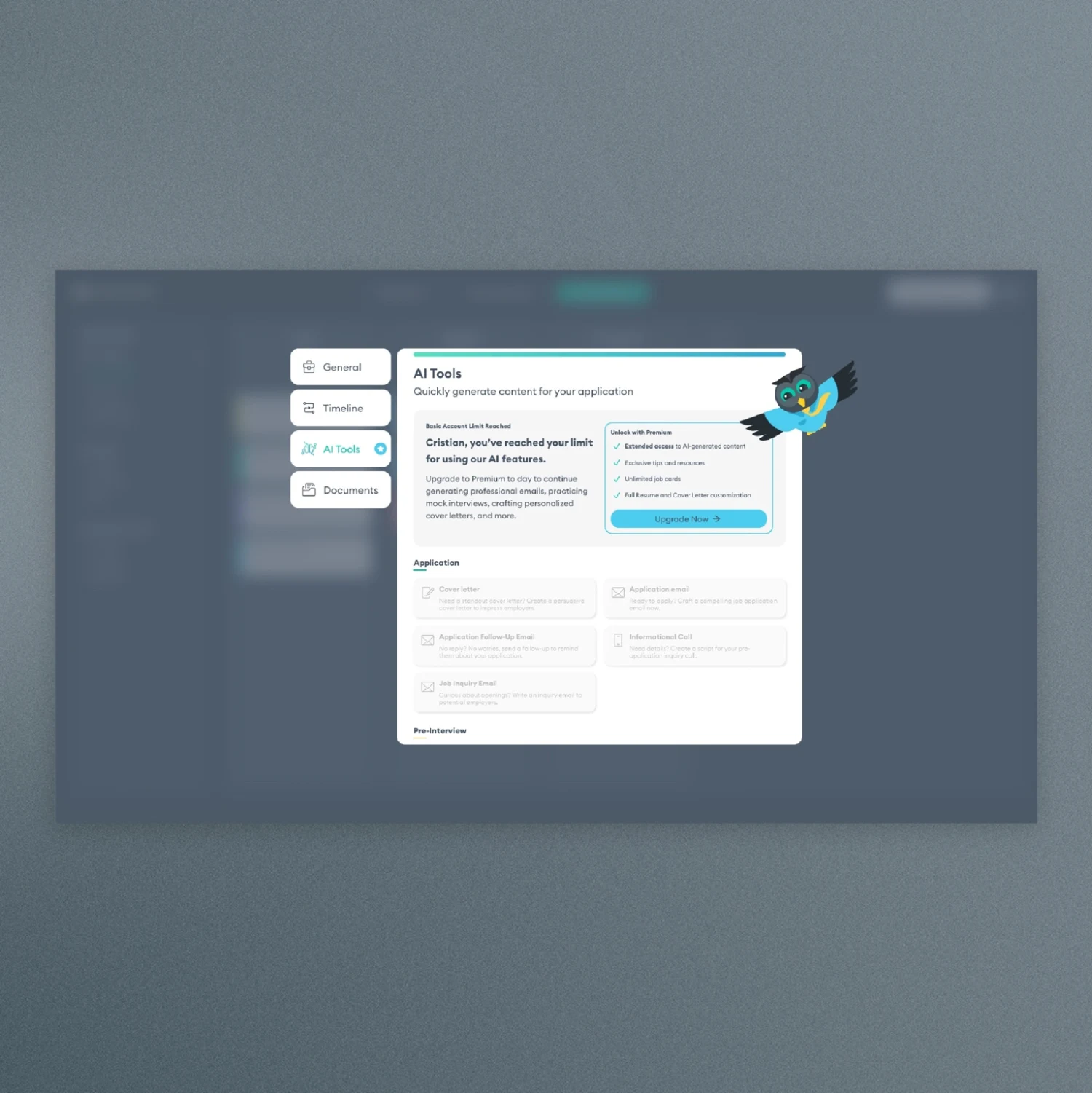
Early models still produced inconsistent results, so the UX explicitly encouraged review rather than presenting generated text as finished work. We also explored the economics of generation — users could try AI functionality before upgrading, while usage limits were adjusted according to generation cost. This let us expose the value before placing the feature behind Premium.
AI should remove unnecessary work without removing the user's judgement.
Flows were designed to prompt review, not present generated text as a finished result.
Create value between applications
Novocareer
Resume creation gives people a reason to visit at a particular moment. Career development creates a much longer relationship. We built a learning product around structured courses, progress tracking and later AI-generated learning content. I owned the product direction, UX and delivery while a colleague owned the course content itself.
A useful product does not distribute itself.
The product received strong qualitative feedback from the people who used it, but overall adoption grew more slowly than we wanted. That became one of the most useful lessons from the project.

Novocareer's course overview, built to give users a reason to return between document edits.
Product leadership meant making trade-offs
As my role moved from Product Owner to Head of Innovation, more of my work became about creating enough clarity for other people to move. I worked across product direction, PRDs, acceptance criteria, analytics planning, release planning, QA, experiments, stakeholder alignment and development prioritisation.
I led product delivery with a cross-functional development team and worked in short iteration cycles. The goal was never documentation for its own sake — documentation existed to make decisions visible, reduce ambiguity and help the team ship.
Mobile was not part of the first release.
Observed behaviour showed the core workflow was predominantly desktop-based.
Ship before completeness.
We deliberately left secondary functionality out of early releases rather than waiting for a comprehensive product.
What shipped
A structured workflow for managing applications and progress.
Assistance across writing, follow-ups and preparation.
Structured career learning with progress tracking.
Clearer requirements, instrumentation, QA and release processes.
Distribution is product work.
One of my biggest lessons from this period was that building something useful is not enough. Go-to-market responsibilities were not always clearly owned, which made adoption of new products harder than it needed to be. Today I treat distribution, launch ownership and measurable adoption goals as part of the product plan rather than something that happens after delivery.
Have something worth building?
I'm interested in senior product, product design and hybrid leadership roles.